Key Takeaways:
- Solar panel temperature can rise significantly under strong sunlight, but this does not automatically mean more heat is transferred into the rooms below.
- Roof material, insulation quality, ceiling construction, and ventilation usually have a greater influence on indoor heat gain than the presence of rooftop PV.
- Proper clearance beneath the modules allows air to circulate, helping heat dissipate instead of remaining trapped against the roof surface.
- During site assessments, we look at the roof as a complete system, including its construction, airflow, existing heat issues, and surrounding obstructions, before planning the installation.
Introduction
In Singapore, rooftops are exposed to strong heat and sunlight throughout the year, even before solar panels enter the picture. The Meteorological Service Singapore describes the climate as hot and humid throughout the year, with mean daily maximum temperatures generally ranging from 30.5°C to 32.4°C. Singapore also receives average annual solar irradiance of around 1,580 kWh/m².
So it is understandable that property owners sometimes ask us whether adding solar panels will make an already warm building even hotter. We hear this concern most often when upper-floor rooms, attics, or roof-level workspaces already feel noticeably warmer during the day.
From what we see on site, though, solar panel temperature is only one part of the story. What has a bigger influence is how the roof itself handles heat, including its material, insulation, ventilation, and the way heat moves through the roof assembly into the space below.
Why Hot Panels Do Not Automatically Mean Hotter Rooms
Solar panels can get noticeably hotter than the surrounding air when they are exposed to strong sunlight. But a hot panel does not automatically mean that the same heat is being transferred into the roof and the rooms below.
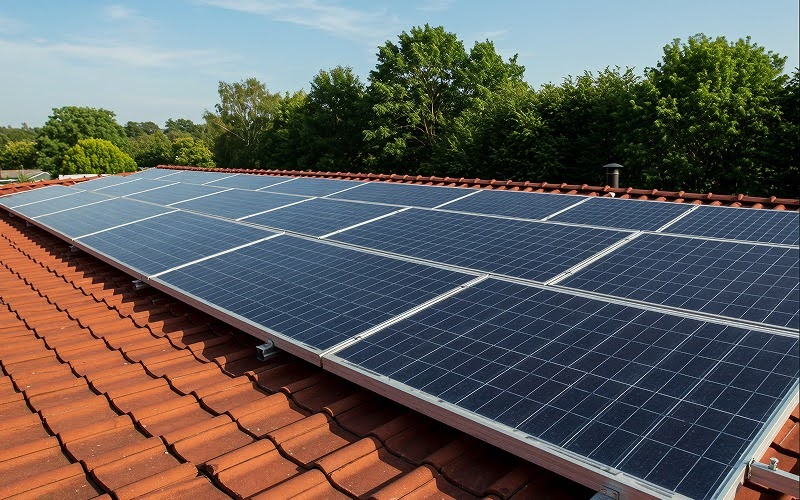
In a typical rooftop installation, the panels are mounted above the roof rather than sitting directly on it. This creates two useful effects: the panels shade part of the roof from direct sunlight, and the gap underneath allows air to circulate and carry some of the heat away.
EMA also notes that rooftop solar panels need ventilation beneath them, partly because excessive heat can reduce the efficiency of the modules themselves.
This is especially relevant for solar panels in a tropical climate like Singapore’s. A high solar panel temperature tells us that the module itself is hot, but it does not tell us how much heat is actually making its way through the roof assembly and into the building.
What We Look at When Assessing Roof Heat
One of the first things we look at during a site assessment is the roof itself. Two buildings can receive roughly the same amount of sun and still feel very different indoors because their roofs absorb, store, and release heat in different ways.
Metal Deck Roofs
Metal heats up quickly under direct sunlight and can transfer that heat into the space below just as quickly, especially if the roof has little or no insulation.
When we assess a metal deck roof, we look at what sits beneath it, including insulation, reflective layers, ceiling construction, and ventilation. Solar panels can shade the sections they cover, but they should not be seen as a replacement for proper roof insulation.
This is especially relevant when planning solar panels for business premises such as warehouses, workshops, and factories, where large metal roof areas can already contribute to noticeable daytime heat.
Concrete Slab Roofs
Concrete behaves differently. It takes longer to heat up, but once warm, it can hold onto that heat and release it later in the day.
On these roofs, we look at factors such as insulation placement, waterproofing, surface finish, and how much stored heat may be passing into the building below.
Panels can reduce the amount of direct sunlight reaching the parts of the slab they cover. This can create differences in solar panel roof temperature between shaded and exposed sections, although the indoor effect still depends on the overall roof construction.
Clay or Concrete Roof Tiles
Pitched tiled roofs usually have an air space beneath the tiles, which provides some separation between the sun-exposed surface and the ceiling below. Even so, attic ventilation can make a noticeable difference.
For solar panels for home installations on landed properties, we therefore look beyond the tiles themselves. We have come across roofs where the panels provide useful shade, yet the upper floor still feels warm because hot air is building up in the attic and has limited opportunity to escape.
In cases like these, the bigger issue is usually how the existing roof and attic manage heat rather than the panels themselves.
Flat Roofs and Waterproofing Membranes
Flat roofs can behave quite differently depending on how they are built. Dark waterproofing membranes tend to absorb more solar heat than lighter or reflective surfaces, while the insulation beneath them plays a major role in determining how much of that heat reaches the interior.
Where panels cover part of the roof, they also create shaded areas that receive less direct sunlight during the day.
This is why saying that solar panels heat up roof surfaces simply because the modules themselves become hot can be misleading. What matters is the full roof assembly and how heat moves through it.
What Roof-Level Research Shows
Research helps explain why the roof beneath a solar array does not necessarily behave the same way as an exposed roof.
A University of California San Diego study on how solar PV panels affect roof heat transfer compared exposed roof areas with sections covered by solar panels. The researchers found that daytime ceiling temperatures beneath the PV arrays were up to 2.5°C cooler. Their modelling also estimated a 38% reduction in annual cooling load for that particular building.
We would not apply that 38% figure directly to a property in Singapore. The study was carried out in San Diego, and factors such as climate, roof construction, panel spacing, ventilation, and building use can all change the outcome.
What is more useful is the principle behind the result. Solar panels can shade the roof from direct sunlight, while the air gap beneath them allows some of the accumulated heat to dissipate.
For us, that is a more practical way to assess roof-level heat than looking at solar panel temperature on its own.
Why Airflow Beneath the Panels Matters
The space beneath a solar array is not just a mounting detail. It plays a practical role in how heat is managed at roof level.
When there is enough clearance for air to move beneath the panels, some of the built-up heat can dissipate instead of remaining concentrated against the roof surface. Airflow can still be affected by factors such as panel spacing, parapet walls, nearby structures, rooftop equipment, and the overall shape of the roof.
That is why we do not plan solar power systems based only on how many modules can fit. We also look at drainage, maintenance access, roof condition, shading, ventilation pathways, and how the array will sit alongside existing rooftop equipment.
When Heat Complaints Usually Point Elsewhere
When clients tell us that their upper floors or roof-level spaces already feel uncomfortably warm, we do not assume solar will make the problem worse. We usually start by looking at how the building is already handling heat.
Poor insulation, limited attic ventilation, dark roof finishes, gaps in the insulation layer, and trapped hot air above the ceiling can all raise indoor temperatures. Changes in air-conditioning use can also make a space feel warmer without having anything to do with the solar installation.
In many cases, these existing conditions have a greater impact on indoor comfort than solar panel temperature itself. That is why it helps to understand what is already happening at roof level before linking a heat issue to the panels.
Do Solar Panels Make Buildings Hotter?
From what we see on site, a properly installed solar array is not usually a major cause of higher indoor temperatures.
The panels themselves can become hot, but the temperature inside the building depends on much more than that. Roof material, insulation, ventilation, ceiling construction, panel clearance, and airflow all affect how heat moves through the roof. In some cases, the panels can also shade parts of the roof from direct sunlight during the day.
At PMCE, we therefore look beyond how much roof space is available. We assess the roof construction, ventilation, access, obstructions, existing equipment, and proposed array layout so the installation fits the building rather than simply sitting on top of it.
If you are considering rooftop solar and are concerned about heat, roof condition, or indoor comfort, contact us for a site assessment. We can review your roof configuration, explain the factors that may affect heat transfer, and help you understand what to expect before moving ahead with the installation.