Artificial intelligence doesn’t run on magic. It runs on electricity – and it is ravenous. To put that in human terms, the International Energy Agency offers a striking comparison:
A typical AI-focused data centre consumes as much electricity as 100,000 households. But the largest ones under construction today will consume 20 times as much. – International Energy Agency, 2025
Singapore is one of the world’s biggest data-centre hubs – and every one of those facilities draws from the same grid that powers your plant in Tuas, your office in the CBD, or your cold store up in Senoko. Here is what that means for your electricity bill, and the one lever you actually hold. (For the bigger picture – how long this crunch lasts and what comes after – see our overview of Singapore’s energy crisis.)
The numbers are hard to overstate
Globally, the IEA expects electricity demand from data centres to “more than double over the next five years, consuming as much electricity by 2030 as the whole of Japan does today”. Demand from data centres already “soared by 17% in 2025” – well ahead of the roughly 3% growth in global electricity demand overall.
Singapore sits at the centre of this in our region: one of the world’s largest data-centre markets, with more than 70 data centres and about 1.4 GW of capacity already running, and data centres already consuming an estimated 7% of national electricity – a share the Ministry of Trade and Industry projects could reach around 12% by 2030. Just across the Causeway, Wood Mackenzie analyst Alvin Tan estimates Johor’s data-centre projects could consume 40% of that state’s electricity by 2035.
Singapore felt the strain early. From 2019 it effectively froze new data-centre approvals over energy, water and land concerns, then reopened growth in 2022 – but only under strict efficiency and clean-energy conditions. In 2024 it set out a Green Data Centre Roadmap to add at least 300 megawatts more capacity, with a further tranche reserved for operators that bring their own clean energy. The message is clear: the demand is too valuable to turn away, so it keeps coming – and the grid keeps absorbing it.
Why a data centre’s appetite shows up on your bill
To be clear, data centres aren’t the villain here – they’re central to Singapore’s digital economy, and to the investment and jobs that come with it. But their explosive growth carries a cost the rest of us share, and it shows up on the electricity bill.
You might reasonably ask: why is someone else’s server farm my problem? Because in Singapore, everyone draws from the same tightly-balanced system. About 95% of our electricity comes from imported natural gas, priced on volatile global markets. We are land-scarce and resource-poor, so you cannot simply switch on new supply – new power plants take years to build, and the Energy Market Authority has warned that if demand grows at the top of its range, the country’s spare capacity could fall below the required level from 2031.
Now add a vast, fast-growing new category of demand on top of that. The EMA already points to data centres as a key reason it expects peak electricity demand to grow by as much as 4.8% a year through 2034. And unlike most demand, a data centre’s load barely lets up – it runs around the clock, every day, lifting the baseline the whole system has to serve at all times, not just at the daily peak. When a constrained, gas-priced grid has to carry more and more of this relentless, high-intensity load, the pressure on prices is upward and the volatility is real. The regulated tariff is reviewed every quarter and moves both ways – but the structural direction, with demand like this climbing, is not hard to read.
You might have heard a reassuring counter-point: new data centres now have to bring their own clean energy – Singapore’s Green Data Centre Roadmap requires it – so surely they aren’t drawing down your supply? It helps, but it doesn’t let the rest of us off the hook. Much of that “clean” power is matched through certificates or regional imports rather than conjured on our shores; the large existing fleet still runs on the same grid you do; and because gas-fired plants set the wholesale price, heavier demand lifts the marginal cost everyone pays. Add the competition for the two scarcest things here – grid-connection capacity and land – and the net effect is a tighter, pricier system for every other user.
Singapore’s own leaders have been candid about the squeeze. As Senior Minister of State Dr Janil Puthucheary put it, “we’re reaching this point of consideration because of our size and resource constraints.” Or, in the words of Wood Mackenzie’s Alvin Tan, “the issue is increasingly about where power is available rather than whether it is available.”
The one lever you actually hold
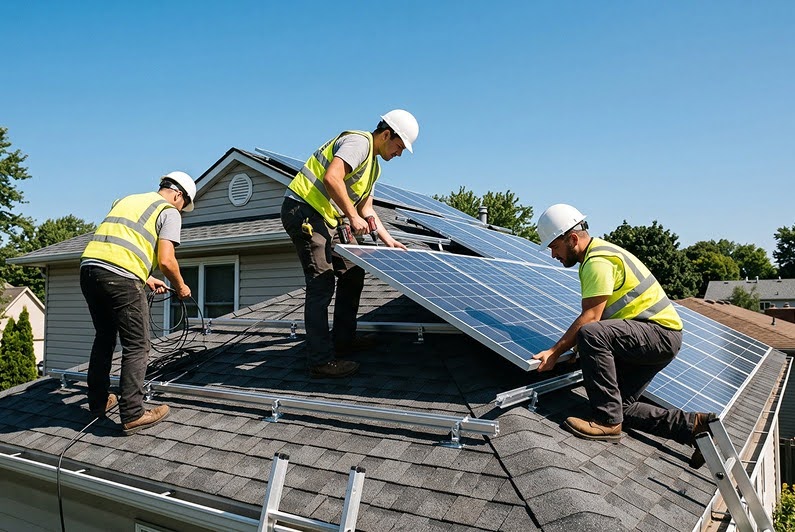
You cannot build a power station, and you cannot slow the AI boom. But you can stop competing for grid power you don’t control – and start generating your own.
Every kilowatt-hour you produce on your own roof is a kilowatt-hour you don’t buy at the rising market rate. That is what makes rooftop solar a genuine hedge, not just a feel-good gesture. For commercial and industrial users the fit is especially good, because you consume most of your power in daylight hours – exactly when your panels are generating. The result: payback in roughly three to six years, electricity-bill savings often in the range of 50-80% depending on system size and usage, and 25 years of power at a cost you fix today rather than re-discover every quarter. And because every unit of solar you use yourself avoids about 0.4 kg of CO₂ from the grid, it quietly improves your sustainability numbers too.
The reason the maths works so well for businesses is self-consumption: a unit of solar you use on-site offsets the full retail tariff you would otherwise pay – worth far more than selling surplus power back to the grid at a fraction of that rate. The better your daytime load matches your generation, the faster it pays back.
It is also the direction the country is moving. Singapore raised its national solar target to 3 gigawatt-peak by 2030, and the Minister-in-charge of Energy, Dr Tan See Leng, calls solar “our most viable option in the near-term”. (For the largest, round-the-clock energy users, there are further ways to manage exposure beyond solar alone – we cover those in our solar-and-storage guide.)
The bottom line
The data-centre boom is not going to pause for the rest of us. If anything, AI will keep the grid tight and prices firm for years. That leaves two kinds of businesses: those who keep bidding for the same scarce grid power as every hyperscaler in the region, and those who quietly take part of their supply into their own hands. The roof over your operation is the cheapest place to start.
Frequently asked questions
How much electricity do data centres use in Singapore?
About 7% of national consumption today, and the Ministry of Trade and Industry projects that could reach around 12% by 2030. Singapore already hosts more than 70 data centres with about 1.4 GW of capacity – one of the largest concentrations anywhere in the world.
Do data centres really push up electricity prices?
Not as a separate line on your bill – but in effect, yes. They add large, around-the-clock demand to a grid that runs about 95% on imported gas and cannot add supply quickly, which keeps wholesale prices and tariffs structurally higher, and more volatile, than they would otherwise be.
How can my business reduce its electricity costs?
The most dependable lever is generating your own power. Rooftop solar fixes part of your supply at a known cost for 25 years or more, and for most commercial and industrial sites it pays back in roughly three to six years – a free assessment will show you the numbers for your specific roof.
Don’t compete with hyperscalers for grid power – make your own.
Get a free PMCE energy assessment and we’ll show you exactly what your roof can do: your solar potential, your projected savings, and your payback – at no cost and no obligation. We’ve installed 1,500+ systems across Singapore over 9+ years, with work featured on CNA, TodayOnline and Lianhe Zaobao.
See what your roof can do → www.pmce.sg