Crisis-proofing your energy: a solar-and-storage playbook for Singapore businesses
You can’t fix the grid. You can’t change the price of imported gas, slow the data-centre boom, or end the energy crunch that Singapore’s own leaders call the challenge of the next 50 years. (We have written separately about how long that lasts and what is driving it.)
But here is what the most exposed businesses have worked out: you don’t have to fix any of that. You only have to stop being fully at its mercy. The part of your energy cost you can actually control – your own generation and storage – is bigger than most owners realise – and unlike the macro picture, it is a lever you can pull this quarter, not in 2035. Here is the playbook, in the order that makes sense.
Step one: put your roof to work
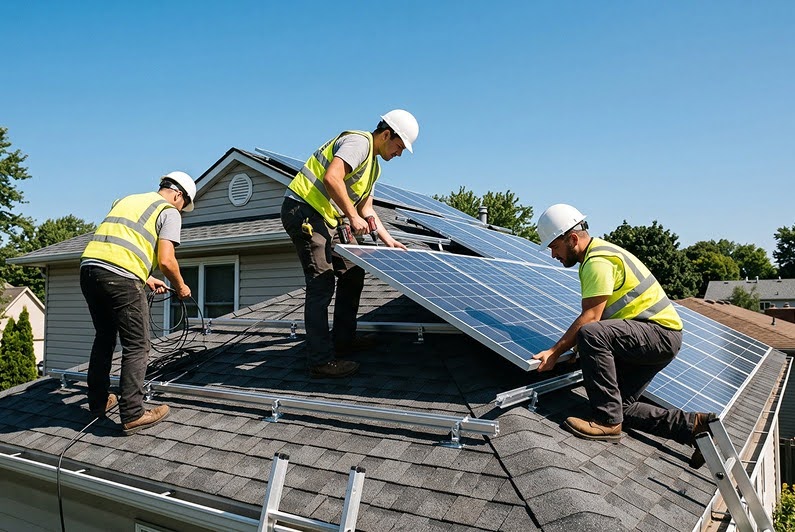
Rooftop solar is the first and biggest move, for a simple reason: it converts part of your electricity bill from a variable you re-discover every quarter into a fixed cost you set for the next 25 years. The timing is ideal, too – commercial and industrial sites use most of their power in daylight hours, which is exactly when panels generate and when grid power tends to be most expensive. That makes solar an especially strong fit for the businesses most exposed to the crunch – manufacturers, cold chain, food production and logistics – anywhere with heavy daytime load and the roof space to match.
The economics are why this isn’t a hard decision for most C&I sites:
- Payback in roughly three to six years – then close to two decades of near-free power.
- Electricity-bill savings often in the range of 50-80%, driven by self-consumption: every unit you use on-site offsets the full retail tariff.
- A direct cut to your Scope 2 emissions – about 0.4 kg of CO₂ avoided for every unit of solar you use yourself.
Here is how the maths typically works – an illustrative mid-sized example, not a specific client; your numbers depend on your roof, load and tariff:
- The system – a 500 kWp rooftop array (a fit for a mid-sized factory or warehouse), generating roughly 600,000 kWh a year.
- The saving – with a daytime-heavy load that self-consumes most of that power, on the order of S$150,000 a year off the electricity bill.
- The payback – around four years; after that, the system keeps producing for another two decades at almost no running cost.
- The carbon – about 240 tonnes of CO₂ avoided every year.
It is also where the country is heading. Singapore raised its national solar target to 3 gigawatt-peak by 2030, and the Minister-in-charge of Energy, Dr Tan See Leng, is blunt about the priority:
Solar remains our most viable option in the near-term. – Dr Tan See Leng, Minister-in-charge of Energy, March 2026
Step two: close the gap with storage
Solar has one limit: the sun doesn’t shine at night, on demand, or through a cloudy afternoon. And in an energy crunch, grid power is often priciest in the early evening – right after your panels wind down. That is the gap a battery closes.
Add storage and three things change:
- You keep more of your own solar. Instead of exporting midday surplus cheaply and buying it back expensively after dark, you store it and use it – lifting the share of solar you actually consume from perhaps 20-30% toward 70-90%.
- You shave the expensive peaks. A battery can cover short, costly spikes in demand, so you draw less from the grid when it is dearest.
- You add resilience. If the grid dips, critical loads keep running – a real consideration for cold chain, production lines, and anything that can’t simply stop.
Together, solar and storage move you from a daytime discount to round-the-clock control of your energy costs.
For the heaviest users, there is a further layer
If you run a large, around-the-clock operation – a cold store, a food-production plant, heavy manufacturing – storage at your scale starts to open up options that go beyond your own savings. The right setup depends entirely on your load profile, so this is a conversation rather than a brochure. If that sounds like your site, it is worth talking to us directly – we will keep the specifics for a one-on-one, because the answer is different for every operation.
Why do it with PMCE
Plenty of companies will sell you panels. Fewer can install fast, integrate the whole system, and still be standing behind it in year ten. That is where PMCE is different:
Speed nobody here matches. Our biggest edge is how quickly we install and commission – faster than other Singapore installers – so you start saving sooner and disrupt your operations less.
One integrated system. Solar, storage and monitoring designed around your load and delivered by one team – not three vendors pointing at each other when something needs fixing.
A track record you can check. 1,500+ systems across Singapore over 9+ years, with work featured on CNA, TodayOnline and Lianhe Zaobao – not claims, but installs you can verify.
Proven hardware, long warranties. JINKO Tiger Neo and AIKO panels, Huawei inverters and FusionSolar monitoring – backed by 25-year product, 30-year performance and 5-year workmanship warranties.
Service that protects your savings. PMCE 365 catches issues before you notice them, so the numbers you were promised are the numbers you keep getting.
Your roof, protected. Worried about leaks or damage? That worry stops many owners – so our crews are trained to protect the roof structure, and every install carries the 5-year workmanship warranty plus PMCE 365 monitoring. It is not a risk you carry alone.
What getting started actually looks like
It is lighter than most owners expect. It begins with a free, roughly 30-minute assessment of your roof, your load and your current tariff – no commitment and no hard sell. From there: a tailored design, the authority approvals (PMCE handles the SP Group and SPPG paperwork), an install that usually takes one to two weeks, then testing, commissioning and live monitoring. Most projects run about four to six weeks end to end – and PMCE 365 watches the system from day one.
The bottom line
The energy crunch isn’t ending; the grid will stay tight and prices firm for years. And waiting has a price of its own: every quarter you stay fully on the grid, you keep paying the rising market rate for power you could have been generating yourself. The businesses that come out ahead aren’t the ones who time the market – they’re the ones who stop renting every kilowatt-hour and start owning their supply. Solar first, storage next. The sooner you start, the more of the next decade’s volatility you lock out.
Stop renting every kilowatt-hour. Start owning your power.
Get a free PMCE energy assessment and we’ll show you exactly what your roof can do: your solar potential, your projected savings, and your payback – at no cost and no obligation. We’ve installed 1,500+ systems across Singapore over 9+ years, with work featured on CNA, TodayOnline and Lianhe Zaobao.
See what your roof can do → www.pmce.sg
Frequently asked questions
Is rooftop solar worth it for a business in Singapore?
For most commercial and industrial sites, yes. Payback is typically three to six years, after which you have effectively fixed part of your power cost for two more decades. The better your daytime electricity use matches when the sun shines, the stronger the case.
Do I need a battery as well as solar?
Not to start. Solar alone delivers the biggest, fastest savings. A battery is the natural next step – it lets you use more of your own solar after dark, shave expensive peaks, and keep critical equipment running through outages. Many sites add it once the solar is already paying off.
What about my roof – will panels cause leaks or damage?
It is the most common worry, and a fair one. PMCE backs every install with a 5-year workmanship warranty and PMCE 365 monitoring, and our crews are trained to protect the roof structure. A site assessment checks your roof’s condition before anything is installed.
We don’t have the budget for a big capital project right now.
Think of it as an investment that funds itself, not a cost. Most C&I systems pay back in three to six years and then deliver close to two decades of near-free power. In the assessment we lay out the full numbers and the options that suit your situation, so you can decide on real figures – not a sales pitch.
How do I know it will actually deliver the savings?
Because we keep watching. PMCE 365 monitors your system’s output against its projection and flags any shortfall before you would notice it, and the hardware is backed by 25-year panel and 5-year workmanship warranties. The savings you are shown are the savings we are on the hook to deliver.
Will the installation disrupt our operations?
Less than most owners fear. A typical commercial install takes one to two weeks, scheduled around your operations, with the noisy and roof-access work planned to avoid your busiest periods. For most sites there is no need to stop production.