Key Takeaways
- Solar reduces reliance on grid electricity, offering a practical way to offset data centre power consumption in Singapore.
- Space limits mean solar cannot fully support high-energy facilities, but hybrid systems broaden overall impact.
- Operators are adopting solar to meet sustainability benchmarks and strengthen long-term energy resilience.
Data centres, production facilities, and other high-consumption operations are central to Singapore’s digital economy and industrial output. These environments require substantial energy to operate around the clock, particularly in facilities with cooling systems, automated machinery, and uninterrupted production processes.
As sustainability becomes a strategic priority, solar energy is being explored as a way to offset environmental impact and manage operating costs. This article examines the role solar can realistically play in powering such facilities, and how businesses are integrating it into broader energy strategies.
Energy Demands in Data Centres Far Exceed Conventional Commercial Buildings
Data centres operate continuously, and their energy usage reflects this unique requirement. Servers run intensive workloads with little downtime, and cooling systems must maintain stable temperatures to protect sensitive hardware. Similar energy pressures are also evident in advanced manufacturing plants and industrial production facilities, where automated systems, climate-controlled environments, and continuous-processing equipment contribute to substantial electricity consumption. The combined load results in far higher per-square-metre consumption than in typical commercial offices or industrial buildings.
Beyond the day-to-day load, redundancy systems add another layer of energy demand. Backup power, emergency supply infrastructure, and network monitoring all contribute to a baseline load that must remain stable 24 hours a day. These conditions highlight why data centre power management needs to be approached differently from standard commercial energy planning. They also strengthen the case for renewable solutions that can support long-term stability and resilience.
Solar Alone Cannot Fully Power Most High-Energy Operations
Solar offers meaningful environmental and operational benefits, but it cannot independently meet the needs of most data centres. In Singapore, land scarcity is the limiting factor. Rooftops are often constrained in size, and many data centres are built vertically, reducing available surface area for panels. Even with high-efficiency technology, the generation potential rarely meets the stringent load requirements of high-energy facilities. This is one reason why organisations evaluating a commercial solar installation often view solar as a supplementary energy source rather than a complete replacement for conventional supply.
Despite these constraints, the contribution of solar should not be underestimated. By offsetting a portion of total consumption, solar helps businesses reduce grid draw, stabilise energy budgets, and improve long-term visibility over cost exposure. For factories and production environments operating heavy machinery or precision manufacturing systems, the challenge is often similar. Solar can offset portions of daytime demand, but full operational support still depends heavily on hybrid infrastructure and stable grid integration. These partial offsets create smoother planning cycles and help organisations manage operational costs more effectively.
Hybrid Systems Combine Solar with Storage and Grid Integration
Because data centres require continuous stability, most operators integrate solar into hybrid energy systems. These systems combine solar generation with battery storage and conventional grid supply. In this configuration, solar does not need to carry the full load to be valuable.
Battery storage retains excess generation during high-output periods and releases it steadily, reducing dependence on the grid. Grid connectivity ensures uninterrupted availability, particularly during demand spikes or periods of low sunlight. Together, these components form a layered system that strengthens data centre power reliability while easing the strain on the grid. A well-planned solar power installation can therefore contribute to greater energy resilience while working alongside existing infrastructure. As technology evolves, hybrid setups are becoming more efficient, predictable, and aligned with long-term resilience goals.
Green Building Certifications Drive Solar Adoption in the Sector
Certifications such as BCA Green Mark and LEED encourage operators to adopt low-carbon, energy-efficient solutions. Solar is often included in a broader environmental management programme that may also feature chilled-water cooling, thermal optimisation, real-time monitoring, and carbon reporting. These combined measures demonstrate compliance with sustainability benchmarks, reduce overall environmental footprint, and align with the expectations of partners, investors, and regulatory bodies.
Incorporating solar also strengthens an organisation’s public sustainability commitments. As demand for transparency increases across the digital economy, solar provides measurable, traceable reductions in electricity-related emissions.
Innovation and Scale Are Expanding Solar’s Role in the Industry
To overcome physical space limitations, hyperscale operators and major technology companies are exploring off-site renewable procurement. Power purchase agreements, large-scale solar farms, and regional renewable partners allow organisations to secure low-carbon electricity without relying solely on rooftop space. These models are also becoming increasingly relevant for industrial operators seeking to decarbonise manufacturing activities without compromising production reliability.
Vertical solar systems, integrated façade panels, and innovative mounting configurations are also being explored to maximise generation within compact footprints. These solutions demonstrate how solar can support data centre power at scale, even when installed capacity on-site is limited.As the sector evolves, broader solar power strategies continue to play an increasingly important role in long-term energy planning and carbon reduction efforts.
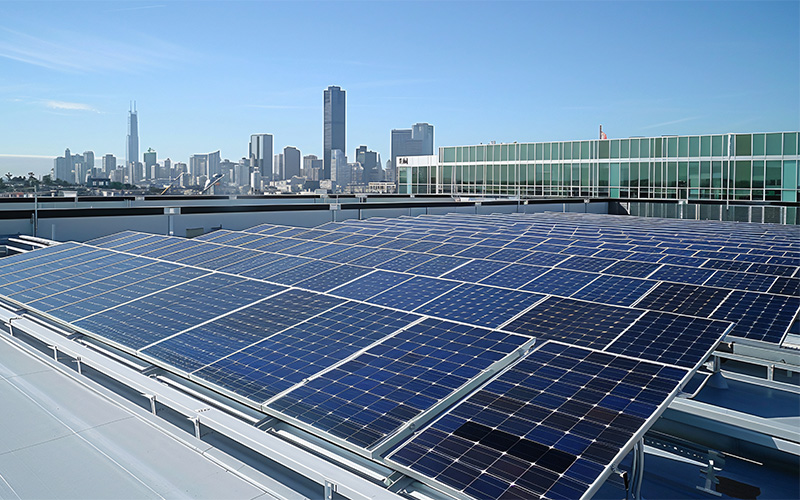
Solar cannot independently power a data centre, yet it provides meaningful support for reducing grid reliance, stabilising long-term energy planning, and strengthening environmental performance. When integrated with storage, cooling optimisation, and smart monitoring, solar becomes a practical and reliable part of a modern data centre power strategy.
Perry Management Clean Energy (PMCE) helps organisations assess the real-world feasibility of solar for their facilities, providing clear analysis, technical insight, and customised planning based on site conditions and operational needs.
If your business is exploring a clean energy strategy for long-term performance and sustainability, PMCE is ready to support your next steps with grounded, practical guidance. Contact us to begin building a tailored solar plan for your facility.